
Indiana Spine Group

Cervical Conditions in Carmel, IN Cervical Stenosis

Introduction to Cervical Stenosis

Narrowing of the Spinal Canal in the Neck

The spine not only provides central structural support and enables flexible movement like bending and twisting, but it also houses and protects your delicate spinal cord, which is the main communication highway between your brain and the rest of your body. When the spinal cord is put under pressure from natural aging and wear and tear, you can experience a variety of symptoms, such as back and neck pain, numbness, and difficulty walking.

If you are experiencing any of these symptoms, you may have cervical stenosis. To treat these symptoms, visit Indiana Spine Group in Carmel, Indianapolis, Westfield, and Kokomo, Indiana, where Dr. Peter Swiatek can help reduce or eliminate your discomfort with a variety of treatments.

Physiotherapist explaining treatment plan using skeleton model to female patient during consultation - Cervical Stenosis in Carmel, IN

What is Cervical Stenosis?

Cervical stenosis is the narrowing of the spinal canal in the neck. When the spinal canal narrows, it puts pressure on the spinal cord and nerves that travel through it, disrupting communication signals from your brain to the rest of your body. Cervical stenosis can cause a variety of symptoms, including neck pain, numbness, tingling, or difficulty balancing.

We offer several options to treat cervical stenosis. During a consultation, Dr. Swiatek will assess your symptoms and determine the best treatment for your unique circumstances.

Cervical Stenosis Treatments We Offer

Dr. Swiatek only recommends surgery when it is truly the best option for his patients. He will typically recommend more conservative solutions first, such as medications, physical therapy, injections, and activity modification, before recommending surgery. If the conservative options do not improve your symptoms, he may recommend one of the following procedures:

What Are Some of the Signs of Cervical Stenosis

Signs of cervical stenosis can show up differently in different patients. Dr. Swiatek’s training and education have prepared him to accurately diagnose cervical stenosis and determine the best treatment for your needs. Some signs of cervical stenosis include:

  • Aching or stiffness in the back of the neck
  • Numbness and tingling traveling down the shoulder, arm, or hand
  • Weakness in one or both arms
  • Shock-like sensations moving down the spine or arms when bending the neck
  • Frequent dropping of items due to lack of grip strength
  • Muscle wasting or shrinkage in the muscles between fingers
  • Difficulty walking or balancing
  • Bowel or bladder incontinence
Woman working on laptop in modern bright office waiting room with white furniture and large windows - in Carmel, IN

How to Begin Your Cervical Stenosis Treatment Journey

A consultation at our Carmel, Indianapolis, Westfield, and Kokomo, Indiana, offices allows Dr. Swiatek to accurately diagnose your condition and find the best path forward to treat your pain and discomfort. Prepare to participate in various tests and answer questions about your lifestyle and symptoms.

  1. Explain your symptoms clearly and honestly, how long you’ve had them, and how severe they are to help Dr. Swiatek assess your condition.
  2. Participate in a variety of tests to test your reflexes, movement restrictions, and strength.
  3. Get MRI, X-ray, or CT scans to pinpoint where the spinal canal and nerve compression exist.
  4. The incisions are closed with sutures, and you may wear a neck brace to keep your neck still and protect healing bones and tissue.


What to Expect During Your Cervical Stenosis Surgery

Do not eat for at least 8 hours before your surgery to avoid aspiration. Your cervical stenosis surgery in Carmel, Indianapolis, Westfield, or Kokomo, Indiana, will take several hours, but you will be under general anesthesia and will sleep completely through the operation.

The surgery itself will look slightly different, depending on the technique used and your specific needs. Here is what you can expect:

  • An incision will be made in the front or back of your neck
  • The damaged discs, bone spurs, or ligaments causing compression are removed
  • Screws, plates, bone grafts, and/or rods are inserted to keep the vertebrae stable
  • The incisions are closed with sutures, and a neck brace may be placed on you to keep your neck still and protect the healing bones and tissues.
  • When you wake up after the surgery, you may feel some grogginess and fatigue from the anesthesia, but we will monitor you and check your vital signs.
  • Some patients may go home the same day while others may stay for observation.
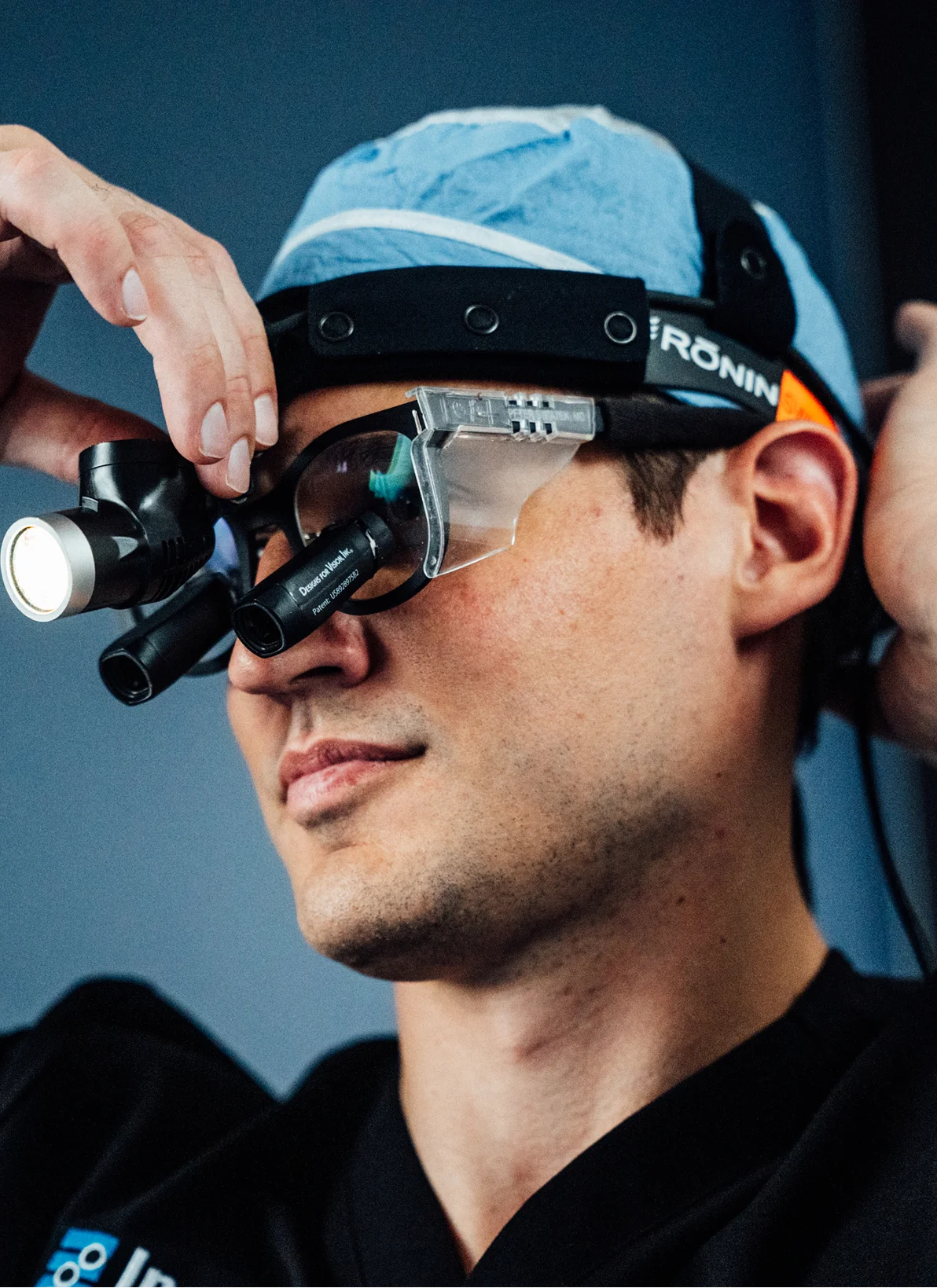
Dr Peter Swiatek wearing surgical loupes with LED headlight for precision medical procedures - in Carmel, IN

Steps to Consider For Optimal Recovery

Your Guide to Post-Cervical Stenosis Care

Recovering from your cervical stenosis requires focusing on a blend of rest, guided physical therapy, posture changes, and movement restrictions. During your consultation, we will review your recovery plan in detail to prepare you for what it will entail.

You’ll also be given written instructions to take home after your surgery. You may contact our Carmel, Indianapolis, Westfield, and Kokomo, Indiana, offices with any questions or concerns. Some crucial recovery steps include:

  • Go to physical therapy to work on safe, gentle range-of-motion and isometric neck exercises
  • Keep your head aligned over your shoulder and avoid looking up or straining forward
  • Use prescription pain medications, anti-inflammatories, or muscle relaxers as directed
  • Go on light walks for the first few weeks to enhance blood circulation
  • Avoid lifting, bending, or twisting anything over 15lbs

How Much Does Cervical Stenosis Cost in Carmel, Indianapolis, Westfield, and Kokomo, IN?

The cost of cervical stenosis treatments in Carmel, Indianapolis, Westfield, and Kokomo, Indiana, can vary significantly from patient to patient and often depends on insurance. Our billing office is available to answer any questions you may have regarding the cost of surgery.

Philosophy

Why Choose Dr. Swiatek?

Treating cervical stenosis requires deep knowledge and understanding of anatomy, not just of the spine, but of how it functions in relation to the rest of the body. Dr. Swiatek’s education at Harvard University and the University of Michigan Medical School, orthopedic surgery training at Northwestern Hospital, and spine surgery fellowship at the Rothman Institute and Thomas Jefferson University Hospital prepared him to diagnose and treat cervical stenosis efficiently.

In addition to his technical excellence in patient care, Dr. Swiatek critically evaluates academic literature before publication and has contributed to several prominent textbooks on spine and orthopedic surgery. He is also a member of the American Academy of Orthopedic Surgeons (AAOS) and the North American Spine Society (NASS).

Teal geometric patterned wallpaper with circular and linear embossed texture in modern minimalist style

Case Studies

He also specializes in repairing failed spine surgeries and revision spine procedures. Dr. Swiatek tailors his treatment plans to the needs of each of his patients, with a focus on non-operative management whenever possible. When surgery is necessary.

Patient Reviews

Trusted by thousands of patients nationwide

“From my first consultation, I felt listened to and never rushed. The doctor clearly explained my options

Joyful woman with curly hair in orange jacket reaching toward sky against blue background - in Carmel, IN
Geometric floral pattern wallpaper with blue radiating sunburst medallions on white background

Start Your Care Today!

Take the First Step Toward Relief