Indiana Spine Group

Lumbar Procedures in Carmel, IN LLIF (Lateral Lumbar Interbody Fusion)

Introduction to Lateral Lumbar Interbody Fusion (LLIF)

Restore Disc Height and Lumbar Alignment

When degeneration causes a disc in the lower spine to lose height or a spinal segment to become unstable, restoring support between the vertebrae may help address the underlying structural problem and relieve nerve pain. Lateral lumbar interbody fusion (LLIF), also known as DLIF, XLIF, and PTP lateral surgery, allows the surgeon to reach the lumbar spine through the side of the body and place an implant within the affected disc space. For patients in Carmel, Indianapolis, Westfield, and Kokomo, IN, Dr. Swiatek carefully evaluates the condition of the lumbar spine to determine whether a lateral approach can provide the stability, alignment, and support needed to address the underlying problem.

Elegant mature woman with gray hair and glasses wearing black outfit sitting on modern sofa in bright contemporary office - ALIF in Carmel, IN

What Is Lateral Lumbar Interbody Fusion?

Lateral lumbar interbody fusion is a procedure used to stabilize and fuse two or more vertebrae in the lower spine. Rather than approaching the lumbar spine directly through the back or abdomen, LLIF reaches the affected disc from the patient’s side. The surgeon removes the damaged disc and places an implant containing a bone graft into the empty disc space. The implant restores support and space between the vertebrae, while the bone graft allows new bone to grow between them, gradually creating a solid fusion. Restoring disc height can also increase the available space for nearby nerves in appropriately selected patients.

Who Are the Best Candidates for Lateral Lumbar Interbody Fusion?

LLIF is not appropriate for every lumbar spine condition or every level of the lower spine. The decision to recommend fusion also depends on whether instability, degeneration, deformity, or another structural problem is responsible for the patient’s symptoms. Candidates around Carmel, Indianapolis, Westfield, and Kokomo may include patients who:

  • Have degenerative disc disease or significant loss of disc height
  • Have spinal instability or certain forms of spondylolisthesis
  • Have spinal stenosis that may benefit from restoring disc height and increasing space around the nerves
  • Have certain spinal deformities, including degenerative scoliosis, that require stabilization or improved alignment

What Are the Benefits of Lateral Lumbar Interbody Fusion?

The lateral approach allows Dr. Swiatek to access certain areas of the lumbar spine without approaching the disc directly through the muscles of the back. LLIF can address several structural problems at the same time, although its specific goals depend on the condition being treated. Potential benefits include:

  • Restores height and support to a damaged or collapsed disc space
  • Stabilizes an unstable or degenerative portion of the lumbar spine
  • Can improve spinal alignment in appropriately selected patients
  • May indirectly create additional space around compressed spinal nerves by restoring disc height
Woman working on laptop in modern bright office waiting room with white furniture and large windows - in Carmel, IN

How to Begin Your Lateral Lumbar Interbody Fusion Journey

Determining whether LLIF is appropriate begins with identifying the structural problem responsible for your symptoms and deciding whether spinal fusion is necessary. Dr. Swiatek prioritizes non-operative management whenever appropriate and considers surgery when conservative treatment has not provided adequate improvement or when the condition requires surgical stabilization, which is why you’ll begin your journey with a consultation in Carmel, Indianapolis, Westfield, or Kokomo. You can expect to:

  • Review Your Symptoms and History: Discuss your back or leg symptoms, previous treatments, medical history, and any prior spine procedures with Dr. Swiatek.
  • Evaluate Your Spine: A physical examination and imaging studies such as X-rays, MRI, or CT scans may be used to evaluate the discs, nerves, spinal alignment, and stability.
  • Determine Whether Fusion Is Appropriate: Dr. Swiatek will assess whether the affected spinal segment requires stabilization and whether LLIF provides adequate access to the treatment area.
  • Plan Your Procedure: If LLIF is recommended, Dr. Swiatek will explain the spinal levels to be treated, the goals of surgery, the planned approach, and what to expect during recovery.

What to Expect on the Day of Lateral Lumbar Interbody Fusion Surgery

LLIF is performed under general anesthesia at our Indiana Spine Group hospital in Carmel, Indiana, or at one of our affiliated hospitals in Carmel, Indianapolis, Westfield, and Kokomo. You are carefully positioned so Dr. Swiatek can access the lumbar spine through an incision along the side of the body. The surgical approach passes through or around muscles to reach the affected disc space while protecting nearby nerves and other structures. The damaged disc is removed, and an appropriately sized interbody implant containing bone graft is placed between the vertebrae. This restores support and disc height while creating an environment for the vertebrae to fuse gradually. Additional spinal instrumentation may be required, depending on the condition being treated and the amount of stability needed. In many instances, screws in the back of the spine are placed through minimally invasive incisions. In larger cases, revision surgeries, or more complex situations, an open approach through the back may be required in addition to the LLIF. After surgery, you will be monitored as you recover from anesthesia and begin postoperative movement.

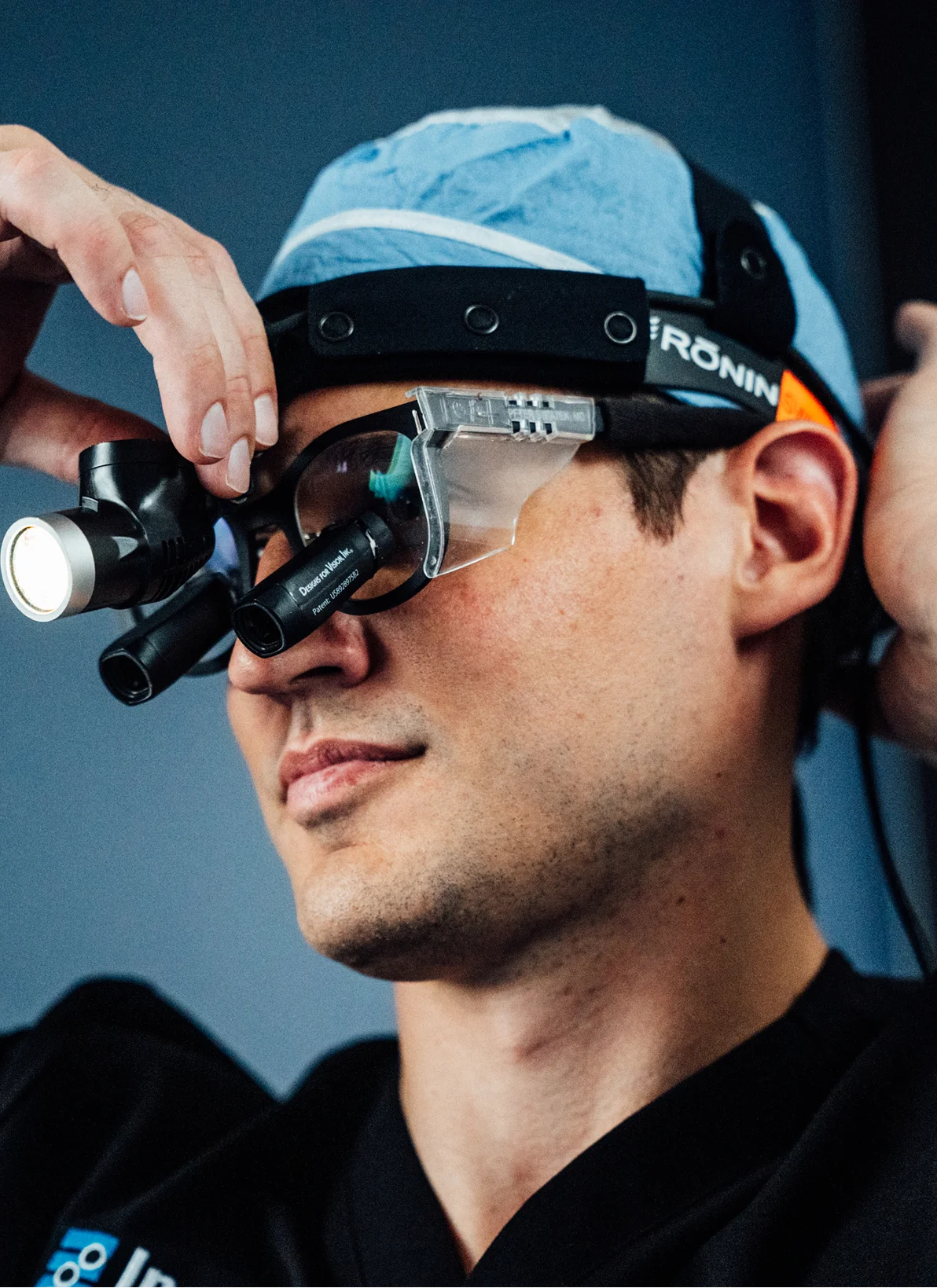
Dr Peter Swiatek wearing surgical loupes with LED headlight for precision medical procedures - in Carmel, IN

Lateral Lumbar Interbody Fusion Recovery

Your Guide to Post-Lateral Lumbar Interbody Fusion Care

Recovery after LLIF varies depending on the number of spinal levels treated, whether additional procedures were performed, and the patient’s overall health. Walking and light movement are generally introduced as recovery begins, while bending, twisting, heavy lifting, and strenuous activity remain restricted during the early healing period. Some soreness or discomfort around the surgical area is expected, and temporary thigh or hip symptoms may occur due to the lateral surgical approach. Follow-up appointments allow Dr. Swiatek to evaluate healing, symptoms, spinal alignment, and the developing fusion. Although patients gradually resume daily activities as recovery progresses, the biological process of spinal fusion continues for several months.

How Much Does Lateral Lumbar Interbody Fusion Cost in Carmel, Indianapolis, Westfield, and Kokomo?

The cost of lateral lumbar interbody fusion in Carmel, Indianapolis, Westfield, and Kokomo, IN, varies depending on the individual surgical plan. Factors can include the number of spinal levels being treated and whether additional procedures are required. Insurance typically covers surgeries involving LLIF. Our billing department is available to answer any questions you may have regarding the cost of surgery.

Philosophy

Why Choose Dr. Swiatek?

Dr. Peter Swiatek is a board-certified, fellowship-trained orthopaedic spine surgeon, is a fellowship-trained spine surgeon specializing in degenerative cervical, thoracic, and lumbar conditions as well as spinal deformity, trauma, tumors, and complex revision surgery. He completed his orthopedic surgery residency at Northwestern Memorial Hospital and his spine surgery fellowship at the Rothman Institute and Thomas Jefferson University Hospital. Dr. Swiatek emphasizes non-operative management when appropriate and uses evidence-based, patient-specific surgical planning when surgery is necessary, focusing on limiting the extent of surgery while adequately addressing the underlying spinal problem. He also has experience with advanced spine surgery techniques and robotic technology and is a member of the American Academy of Orthopedic Surgeons (AAOS), North American Spine Society (NASS), and the American Board of Orthopaedic Surgery (ABOS).

LLIF (Lateral Lumbar Interbody Fusion) FAQ’S

Teal geometric patterned wallpaper with circular and linear embossed texture in modern minimalist style

Case Studies

He also specializes in repairing failed spine surgeries and revision spine procedures. Dr. Swiatek tailors his treatment plans to the needs of each of his patients, with a focus on non-operative management whenever possible. When surgery is necessary.

Patient Reviews

Trusted by thousands of patients nationwide

“From my first consultation, I felt listened to and never rushed. The doctor clearly explained my options

Joyful woman with curly hair in orange jacket reaching toward sky against blue background - in Carmel, IN
Geometric floral pattern wallpaper with blue radiating sunburst medallions on white background

Start Your Care Today!

Take the First Step Toward Relief